

- Dorset Safeguarding Children Partnership training in domestic abuse
If you have not already attended the Partnership’s training in domestic abuse, we recommend you do so. The training is available via Dorset Nexus here
This introductory course will cover the following areas:
- Types of Domestic Abuse, Honour Based Violence, Forced Marriage, Stalking and Harassment & Control and Coercive Behaviour
- Possible indicators of Domestic Abuse
- Effects of Domestic Abuse and Controlling and Coercive Behaviour
- Signposting to identify where victims of abuse can be referred for support as well as perpetrators
- Barriers to reporting to police
- Risk Management and Assessment
- Multi Agency Risk Assessment Conference (MARAC) / High Risk Domestic Abuse (HRDA)
- Legislation Tools and Powers
- Communication Skills
The intended outcomes of the training are as follows:
1. Confidently summarise the different types of domestic abuse
2. Identify the indicators of domestic abuse
3. Demonstrate understand of the cycle of abuse
4. Candidates will have explored and reflected on the impact of domestic abuse upon victims, children and babies
5. Delegates will be familiar with the MARAC/HDRA process will know how to respond following a disclosure
2. Identifying domestic abuse
When assessing families who may experience domestic abuse, it is good to bear in mind the following:
- Domestic abuse undermines the parent/child relationship
- The victim should not be ‘blamed’ for the abuse that they and their children have experienced
- Assessing the non-abusive parent as ‘failing to protect’ their child/children is not helpful
- Recognising and assessing the impact on both the victim and children is crucial
- Effective intervention should focus on strengthening the parent/child relationship not further serving to undermine it
- There are several group work programmes that focus on strengthening the parent-child relationship – find out what is available in your area
- Standard parenting approaches and programmes may not be appropriate to address the pervasive impact of domestic abuse
- Remember it can be common to see both partners using unhealthy behaviours and we won’t always see a clear ‘perpetrator/victim pattern’
- Use culturally competent and trauma-informed approaches
Domestic abuse Champions
Dorset has a team of domestic abuse Champions who can offer information and support to professionals working with suspected incidences of domestic abuse. They can be contacted as follows:
Debbie Wood debbie.wood@dorsetcouncil.gov.uk
Hilary R Foster Hilary.R.Foster@dorsetcouncil.gov.uk
Natalie Minns natalie.minns@dorsetcouncil.gov.uk
Sandra Brown sandra.brown@dorsetcouncil.gov.uk
Shelley White Shelley.White@dorsetcouncil.gov.uk
Tamara Dommett tamara.dommett@dorsetcouncil.gov.uk
Bridget Azzaro bridget.azzaro@dorsetcouncil.gov.uk>
Claire Pennington claire.pennington@dorsetcouncil.gov.uk
Courtney Adams Courtney.Adams@dorsetcouncil.gov.uk
Jacqueline Patrick Jacqueline.Patrick@dorsetcouncil.gov.uk
Linda Mee linda.mee@dorsetcouncil.gov.uk
Paul Lawrence paul.lawrence@dorsetcouncil.gov.uk
Rozanna Essex rozanna.essex@dorsetcouncil.gov.uk
Samantha Griffiths samantha.griffiths@dorsetcouncil.gov.uk
Georgina Cuff georgina.cuff@dorsetcouncil.gov.uk
Sonia Tibble sonia.tibble@dorsetcouncil.gov.uk
Shannen Gibson shannen.gibson@dorsetcouncil.gov.uk
Phoebe Steer phoebe.steer@dorsetcouncil.gov.uk
Responding to indications of domestic abuse
Whilst a child or adult may sometimes disclose domestic abuse, it is more likely to be identified by a practitioner who suspects and then asks about abuse, as set out in Section 3. However an indication of abuse comes to you, it will be helpful for you to follow the following 3-step approach:
1 Receive
• Listen, do not look shocked or disbelieving.
• Do not be judgmental.
• Take what they are saying seriously and believe them, tell them you are glad they told you, that they are not alone and it’s not their fault.
• Don’t make the child feel bad, for example, by saying something like, “You should have told me earlier.”
2. Reassure
• Stay calm, tell them that they have done the right thing in telling you.
• Acknowledge how hard it must have been to tell you.
• Tell them that they are not to blame.
• Empathise – but don’t tell them how they should be feeling.
• Don’t promise confidentiality – explain that only those that need to know will be told.
• Be honest about what you can and can’t do.
3. Respond
• Don’t interrogate – let them tell you as far as possible.
• Record the date and time and any information given to you.
• Always use the words said to you; never interpret what was said and put it in your own words (this information could be used as evidence).
• Make a note of any injuries you have seen or been shown; this is very important as bruises, cuts, marks, etc tend to heal, and this could be used as evidence.
• Record what you did next and with whom you shared the information – ensure that all this is in line with policies and procedures.
• Sign and date everything that you record.
• Don’t criticise or judge the abuser – the child or young person may have feelings for him or her; remember, abuse often happens by someone known and trusted by the child or young person.
• Try to follow things through yourself so they don’t need to repeat their story to other staff – again, only if this is in line with your child protection policy and procedure.
• Explain what will happen next – who may want to speak to the child/young person further; if it is safe, the non-abusing parent or carer might also be informed (but always take great care where there is domestic abuse) – the police might also be informed. For more information see the guide on when to involve the police.
The SafeLives DASH checklist
If you suspect domestic abuse is occurring, you must report this in accordance with your agency child safeguarding procedures. Remember, even a child who is a witness to domestic abuse is also themselves a victim.
The lead professional assessing the child and their family should complete the SafeLives DASH checklist to assess the level of risk involved. Where the completed assessment has fewer than 7 ticks, the family should be referred (with their consent) to Victim Support. Where the assessment has 7 to 14 ticks, the family should be referred to Paragon Dorset which helps families to escape from domestic abuse, sexual violence and stalking. Where the assessment has more then 14 ticks, or where professional judgment dictates, the family should be referred to the High Risk Domestic Abuse (HRDA) pathway.
A Dash Risk Checklist has also been developed for young people, typically used to identify specific considerations for 13 – 17 year olds, and can be used to inform referrals to HRDA and Children’s Social Care.
The HRDA pathway
HRDA is a multi-agency response to high-risk cases of domestic abuse in Dorset. HRDA combines a range of multi-agency functions which complement one another to increase the safety of people experiencing domestic abuse and their families (or known individuals) who are at high risk of harm / future harm and reducing the risk of domestic homicide.
HRDA enables the available information to be safely shared across relevant partner agencies and multi-agency bodies including MAPPA (Multi Agency Public Protection Arrangements) and both child and adult safeguarding conferences, resulting in a clearer picture of the risk level.
This also supports a more comprehensive action plan to be developed to identify and agree risks plus mitigating factors with clear ownership to reduce the risk of harm to the victim and their children.
At the heart of the HRDA framework is the SafeLives Dash risk checklist, which can be found through the link given above. You may also wish to refer to Guidance on completing the checklist. The purpose of the Dash risk checklist is to give a consistent and simple tool for practitioners who work with adult victims of domestic abuse in order to help them identify those who are at high risk of harm and whose cases should be referred to an HRDA meeting in order to manage their risk.
All cases assessed as high risk must be referred to the HRDA single point of contact via hrdacounty@dorset.pnn.police.uk including a copy of risk assessment and completed referral form. Where a medium level of risk is identified, the person experiencing abuse will be referred for casework support from Paragon; where the level of risk is low, they will be referred or signposted to Victim Support.
Whilst the HRDA framework contributes to more effective multi-agency working, individual agencies remain responsible for taking all necessary safeguarding actions. This means that where you identify that domestic abuse may be occurring, you should not wait for an HRDA meeting to happen before taking the steps required in our core safeguarding procedures.
• If there is an immediate risk of significant harm, call 999.
• If there is a non-immediate risk of harm, discuss the matter with the Children’s Advice
and Duty Team (ChAD) on 01305 228558. This will allow further discussion to take
place with you to determine the level of need, support and next steps required.
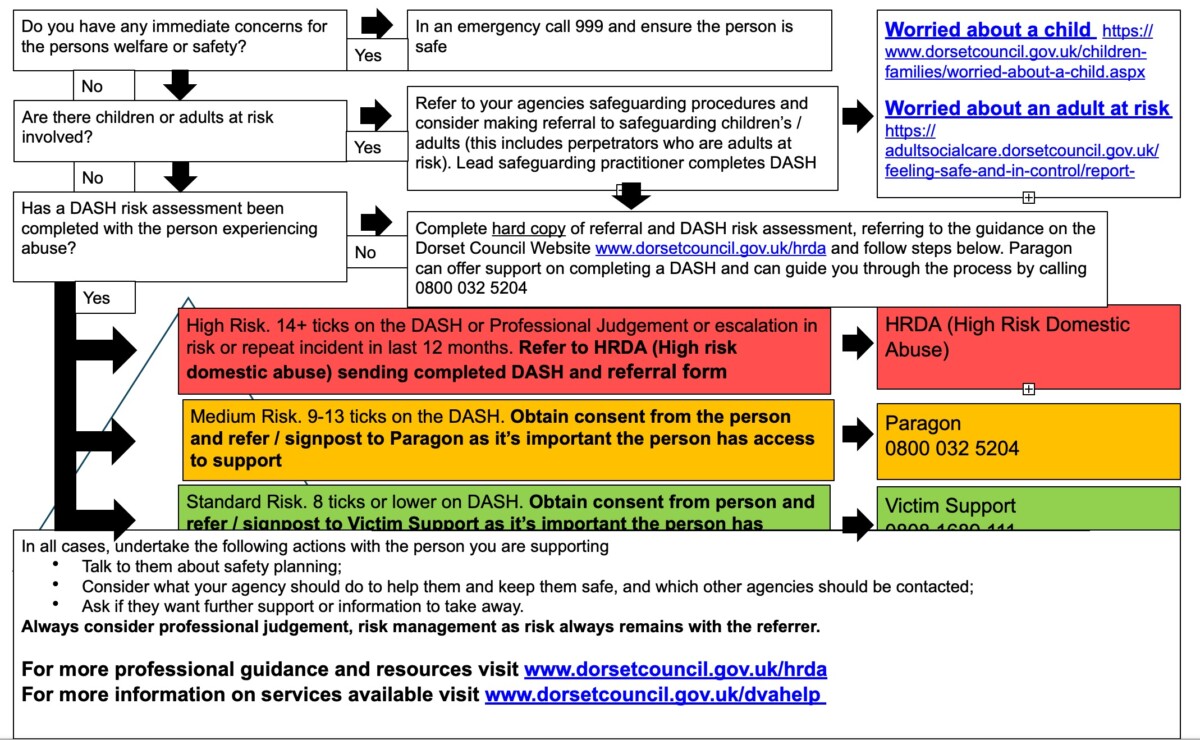
The flowchart below summarises the domestic abuse response pathway
Domestic Abuse – What should I do if a person I am supporting discloses that they are experiencing domestic abuse? (Sep 2024 Final – Designed and agreed by the HRDA (High Risk Domestic Abuse) Quality Assurance Group)
DASH 2009 – for Stalking, Harassment and Honour-based Violence
If the family you are working with have experienced Stalking, Harassment or Honour-based violence, it is important that you also complete the DASH 2009 – 2024 assessment, so that these risks are fully assessed.
3.Legal redress against domestic abuse
There are a range of legal orders and notices that protect families who are experiencing domestic abuse. It is important that families are aware of these orders, as these may give them the confidence to give evidence against their abuser.
Domestic Violence Protection Orders (DVPO)
These orders were created by the Domestic Abuse Act 2021. Government guidance states that:
DVPOs are a civil order that fills a “gap” in providing protection to victims by enabling the police and magistrates’ courts to put in place protective measures in the immediate aftermath of a domestic violence incident where there is insufficient evidence to charge a perpetrator and provide protection to a victim via bail conditions. It is important to note that bail with conditions and protective measures can be used simultaneously to build up greater protection for the victim.
Domestic Violence Protection Notices (DVPN)
A DVPN is an emergency non-molestation and eviction notice which can be issued by the police, when attending to a domestic abuse incident, to a perpetrator. Because the DVPN is a police-issued notice, it is effective from the time of issue, thereby giving the victim the immediate support they require in such a situation. Within 48 hours of the DVPN being served on the perpetrator, an application by police to a magistrates’ court for a DVPO must be heard. A DVPO can prevent the perpetrator from returning to a residence and from having contact with the victim for up to 28 days. This allows the victim a degree of breathing space to consider their options with the help of a support agency. Both the DVPN and DVPO contain a condition prohibiting the perpetrator from molesting the victim.
Non-molestation Order
The National Centre for Domestic Violence states that:
A non-molestation order is typically issued to prohibit an abuser from using or threatening physical violence, intimidating, harassing, pestering or communicating with you. An order could prevent the abuser coming within a certain distance of you, your home address or even attending your place of work. It could also include your children in certain circumstances. An order will also prevent an abuser from instructing or encouraging others to do any of those actions.
A non-molestation order can protect you against behaviour that by itself may not be a criminal offence or in situations where the police have responded to a 999 call but then taken the view that there is insufficient evidence to charge your abuser with a criminal offence such as assault. If you have a non-molestation order in place, then the police can arrest your abuser for the offence of breaching that order.
Occupation Order
An occupation order sets out who may live in the family home after domestic abuse has taken place. Government information states that:
You can apply for an occupation order if you’re a victim of domestic abuse and meet the requirements. The order will say who can live in the family home or enter the surrounding area.
You can apply if:
- you own or rent the home and it is, was, or was intended to be shared with a husband or wife, civil partner, cohabitant, family member, person you’re engaged to or parent of your child
- you do not own or rent the home but you’re married or in a civil partnership with the owner and you’re living in the home (known as ‘matrimonial home rights’)
- your former husband, wife or civil partner is the owner or tenant, and the home is, was, or was intended to be your shared matrimonial home
- the person you cohabit or cohabited with is the owner or tenant, and the home is, was, or was intended to be your shared home
Restraining Order
Crown Prosecution Service (CPS) guidance states that:
Restraining orders may be made on conviction (section 360 SA 2020) or acquittal (section 5A PHA 1997) for any criminal offence. These orders are intended to be preventative and protective. The guiding principle is that there must be a need for the order to protect a person or persons. A restraining order is therefore preventative, not punitive.
Restraining orders can only be made in respect of the defendant (not the victim or any witness).
For a restraining order on conviction, section 360 SA 2020 provides that a court (in the course of dealing with an offender) may make a restraining order for the purpose of protecting the victim or victims of the offence, or any other person mentioned in the order, from conduct which amounts to harassment, or will cause a fear of violence.
For a restraining order on acquittal, section 5A PHA 1997 provides that a court may make a restraining order if it considers it is necessary to protect a person from harassment by the defendant.
In addition to these orders, there are two further protective measures available to those experiencing domestic abuse:
Clare’s Law (Domestic Violence Disclosure Scheme)
Government guidance states that:
The scheme has two elements: the “Right to Ask” and the “Right to Know”. Under the scheme an individual or relevant third party (for example, a family member) can ask the police to check whether a current or ex-partner has a violent or abusive past. This is the “Right to Ask”. If records show that an individual may be at risk of domestic abuse from a partner or ex-partner, the police will consider disclosing the information.
The “Right to Know” enables the police to make a disclosure on their own initiative if they receive information about the violent or abusive behaviour of a person that may impact on the safety of that person’s current or ex-partner. This could be information arising from a criminal investigation, through statutory or third sector agency involvement, or from another source of police intelligence.
A disclosure can be made lawfully by the police under the scheme if the disclosure is based on the police’s common law powers to disclose information where it is necessary to prevent crime, and if the disclosure also complies with established case law, as well as data protection and human rights legislation. It must be reasonable and proportionate for the police to make the disclosure, based on a credible risk of violence or harm.
- Domestic Violence Protection Notices (DVPNs) and Domestic Violence Protection Orders (DVPOs) guidance – GOV.UK (www.gov.uk), s1.2
- Domestic Violence Protection Notices (DVPNs) and Domestic Violence Protection Orders (DVPOs) guidance – GOV.UK (www.gov.uk), s1.3
- Get an injunction if you’ve been the victim of domestic abuse: Who can apply: occupation order – GOV.UK (www.gov.uk)
