

6.1 Using the personas and case studies
Parents who misuse drugs and alcohol do so for many reasons, but traumatic events are a common occurrence and increase vulnerability to addiction. Evidence shows that those who have experienced childhood trauma have an increased tendency to become dependent on drugs and alcohol particularly if their parents have had addiction issues. Shame, guilt, low self-esteem and poor self-confidence are common with these parents along with inability to reflect upon how their misuse of substances impacts upon their children. If parents have themselves been the children of parental substance misuse they often cannot reflect that this has affected them and may be the cause of their low confidence and self-esteem. There are often substance issues that have been passed through generations because of genetic predisposition and learnt behaviours.
We have developed the personas in this section to encourage you to think about the role of trauma in the formation of drug and alcohol misuse, and about the traumatic impact that parental misuse can have on children. The personas can inform your own reflective practice but can also be used as the basis of case study discussions with colleagues. For each person, you may wish to consider:
- How might you engage with the individual(s)? What impact may trauma have on the development of your relationship with them? How might you address these?
- What protective factors are present?
- What risks are there?
- Which agency partners may be able to support your work?
- What range of possible outcomes can you foresee?
Not all parents who misuse substances or alcohol have experienced trauma. Anyone can misuse, and we should not imagine that there are ‘typical’ groups of parents who misuse. In all work with parents, it is important to look behind the presenting issues.
6.2 How should I approach the issue of substance misuse?
The use of substances cuts across all aspects of society and substances can be used in a context of social use right through to problematic or dependant use. Although it can be seen as a problem, invariably it is a symptom of other issues and problems and so should always be viewed as individual to the service user. Given the individual nature, the initial approach to supporting someone should be holistic, non-judgemental and non-confrontational so as to enable the individual to feel supported to make informed choices to change.
The following information is intended to support the professional in being confident to ask the questions as they are in the front line of health and social care services where alcohol and other drug use can play a significant role in the lives of people who use services. For more information on the range of practice models in use, see section 3 of this toolkit [link].
As a starting point, you shouldn’t assume that other professionals will have assessed for alcohol and drug problems, so don’t be afraid to ask; if you don’t understand what people say about alcohol or drugs, don’t worry, they can explain. Remember that nobody starts drinking or using drugs intending to develop a problem, avoid preconceptions or judgemental approach as there is prejudice and stigma regarding substance misuse.
It is worth remembering that even brief interventions from front-line workers can help people change and do your best to view alcohol and drug use in its wider context: is it making any problems worse or is it helping to reduce them?
Professional workers routinely assess the range of needs people have but may be less informed on alcohol and drug issues. If this key area of need is missed, interventions for other issues will not be so effective.
Drinking and using drugs are associated with many problems familiar to professional workers. Those problems are not necessarily caused by the use of alcohol and drugs but may be related. Routine, individual assessment is therefore essential.
While there will be evidence of alcohol or drug use in some cases, there is no magic checklist of signs and symptoms to ‘spot’. Routinely asking sensitive questions is therefore vital, people frequently forget to ask about drugs, including prescription drugs. If drug use is identified it is easy to be distracted by it. Drug use is only ever part of the picture; the person’s behaviour and experiences need to be assessed as a whole. In a similar way, drinking is so common it may simply be overlooked, especially when there are other obvious problems. Because alcohol use is the norm, it should always be addressed. Many drug users have even worse problems with alcohol.
Changing problematic alcohol or drug use can be hard, physically and psychologically. People will often resist imposed changes but can and do change with the right support and motivation.
The Stages of Change is a model for helping people to understand the process of behaviour change (Prochaska and DiClemente 1983). Change is viewed as a progression from precontemplation, to contemplation, to preparation for change. If successful, the next stages are action and maintenance. Never advise anyone to just stop using or drinking – sudden withdrawal can cause serious health problems and can be fatal. Help people to think about change and support them to get the physical and psycho-social support they may need.
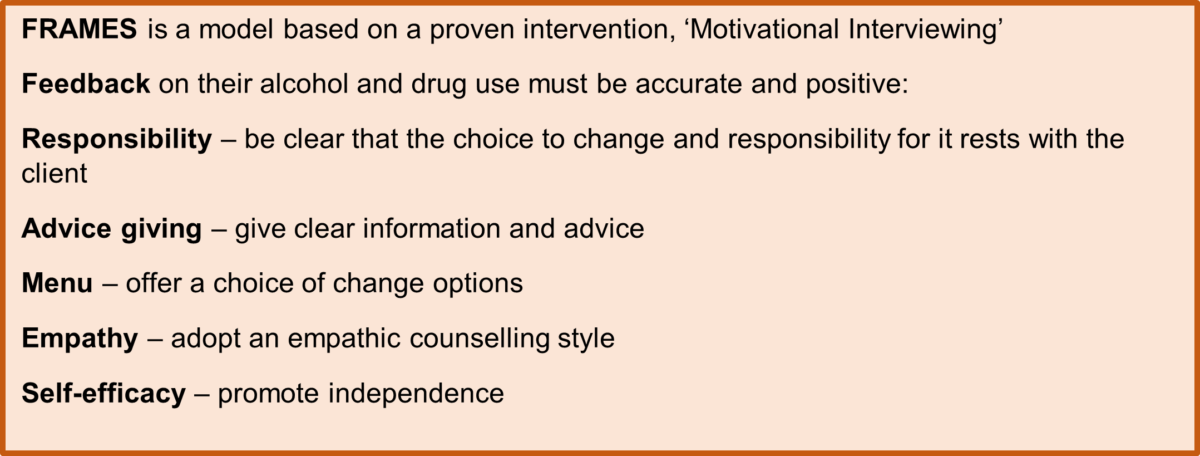
Helping people talk about their drinking or drug use is about asking the right questions in the right way. Tone of voice and an empathic approach are crucial. The key information to ask about includes:
- What are people using?
- How much are they using?
- How often do they use?
- How do they use (smoke, swallow, inject)?
- What are the effects for them – positive and negative – of using drugs?
- What happens if they stop using?
Slang is often used to describe drugs. If you don’t understand – ask the person to explain. This acknowledges the person’s expertise in their own use and is part of an empowering approach. With illegal drug use, people may be wary of telling professionals what they use. An assertive, empathic social work approach can be effective.
Key questions that may help include:
- What do you want from your drug use?
- Do you always get it?
- Are there other ways you could get the same things?
- Would you like to change your drug use?
- What help do you think you might need?
People respond differently to different drugs at different times. Don’t assume you know the effects a drug will have on someone. Ask them.
Other risks:
People with alcohol and other drug-related problems and their families are vulnerable to
other risks. Make sure you ask about them.
Suicide and self-harm prevalence is much greater among people with drink and drug problems.
Domestic violence and abuse is highly correlated with problem drinking and drug use.
Mental ill health often co-exists with alcohol or drug problems and both issues need to be
addressed through partnership working.
Physical health problems may be caused or exacerbated by alcohol and drug use.
Childcare: alcohol and drug use may impair parenting capacity but neglect or abuse should
not be assumed. Assess: is support needed?
To provide feedback on this toolkit please click this link
The QR code to take you to the survey is below:

